
BIOTECH
MEDIA / EVE V
Dr. Kao Discusses Skin Assessment Before Personalized Aesthetic Care
Original article published May 11, 2024
繁中 | EN

In this NOW Health report by Yang Chih-ching, Dr. Kao (高珮菡), a dermatologist at 安澐診所, emphasizes understanding the skin before choosing products or procedures. Incorrect cleansing or ingredients can leave skin more sensitive instead of improving it.
Skin concerns are often combined
The physician discusses environmental irritation and why a single dry, oily or sensitive label may not explain the full picture. Rosacea-like redness or visible vessels can accompany sensitivity; acne and bacterial concerns can accompany oiliness; and pigment visible at the surface may include a deeper component. These distinctions require clinical assessment.
Imaging supports the consultation
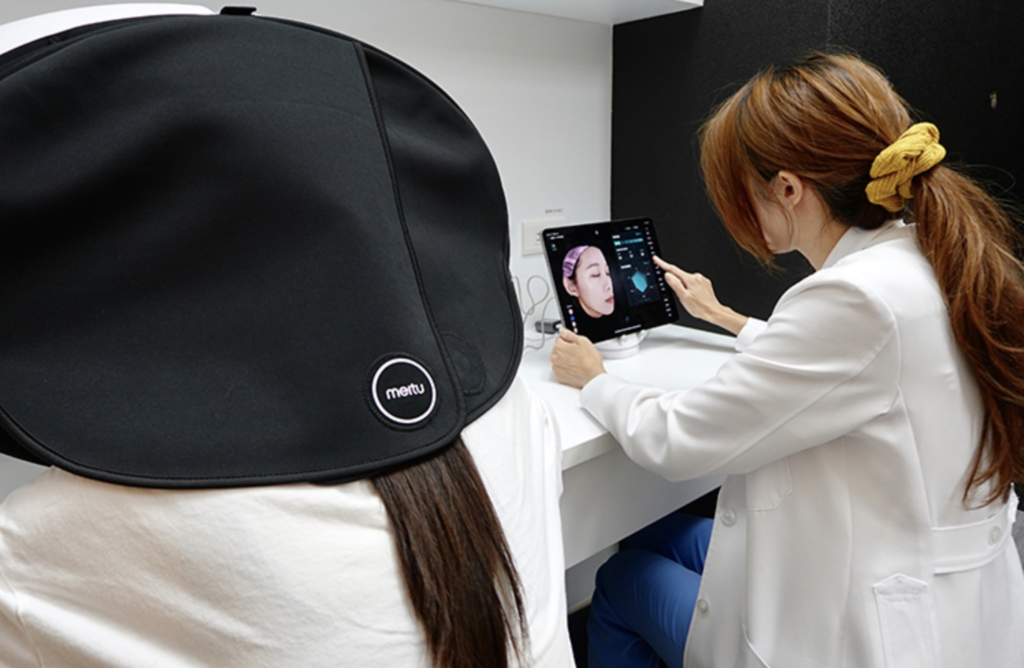
The feature presents EVE V’s AI-assisted analysis of 17 skin concerns at the time of the report, including pores, wrinkles, pigmentation, sensitivity-related patterns, radiance and several eye-area or forehead concerns.
The five-camera system and synchronized imaging are described as supporting three-dimensional structural review as well as skin analysis. Lower-face contours, nasolabial folds and eye-area laxity can therefore be discussed alongside surface findings when a clinician considers energy procedures, fillers or other approaches.
Immediate reports, comparisons with Asian-population data, skin-age indicators and LINE-connected communication are also discussed. These tools give doctor and patient a shared reference; they do not independently choose a treatment.
Avoid common care mistakes
Dr. Kao describes using the distribution of comedones to guide an assessed cleansing approach, including JetPeel in the original examples, followed by suitable formulations. Pigment and texture findings can help inform a physician’s laser-parameter choices.
The interview cautions against over-exfoliation. It cites an approximately 28-day adult skin-renewal cycle and explains how repeated irritation can reduce resilience and cause redness or flaking. Large pores also do not always mean a blockage to squeeze: hydration or scarring may be part of the concern.
The feature concludes that a fuller professional assessment can help people avoid spending on unsuitable products or procedures.
Source: NOW Health report reproduced on HERBEST. Original article images retained.
Images from the Original Article
BIOTECH
Where expertise and aesthetics meet.
Linkou Headquarters
Taichung Office
This website is intended for medical and biotechnology professionals. Members of the public should consult a qualified healthcare provider.
© 2026 HERBEST BIOTECH