
BIOTECH
RESEARCH / EVELAB ARCHIVE
MeituEve Reports Research on Facial Aging, Genetics and 3D Analysis
Original article published January 13, 2023
繁中 | EN
HERBEST’s archive carries a MeituEve / GlobeNewswire release dated July 11, 2022, shared on the HERBEST website in January 2023. The release describes collaboration with researchers from the Chinese Academy of Sciences on quantifying facial aging and studying its relationship with facial morphology.
Nasolabial folds and facial structure
The release records research presented at the Society for Investigative Dermatology meeting in Portland on May 18–20, 2022. MeituEve’s image-analysis work was combined with a research team led by Dr. Sijia Wang at the Shanghai Institute of Nutrition and Health.
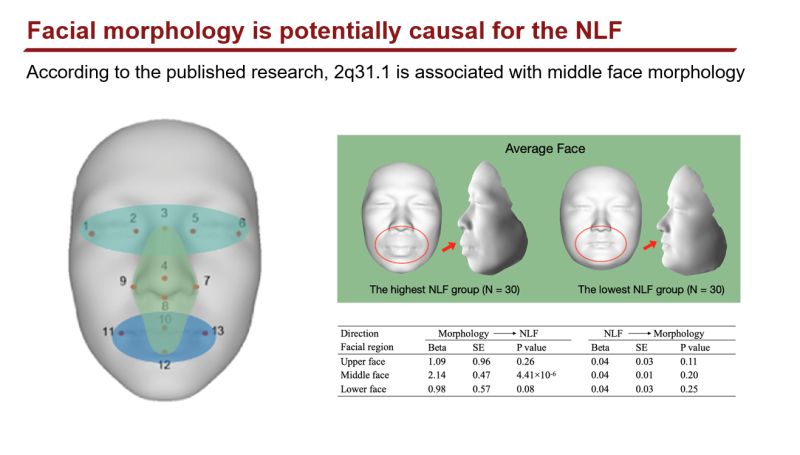
According to the release, an AI scoring approach on a 0–100 scale quantified nasolabial-fold patterns in 12,980 participants for a genome-wide association study. The researchers also reviewed three-dimensional facial data and reported an association between more pronounced folds and midface morphology.
These findings are described as research into the relationship between aging signs and facial structure, rather than a clinical test that predicts an individual’s genes or treatment outcome.
Quantifying aging signs with algorithms
The release also describes an oral presentation at the International Society for Biophysics and Imaging of the Skin meeting on June 2–3, 2022. The team compared deep-learning analysis with conventional methods and discussed the development of its algorithms following earlier work presented in 2018.
The Eve Research & Innovation Center reported expanding analysis dimensions and refining detection. Comparisons involving MeituEve M and other devices are claims from the original manufacturer release, not an independent current product comparison by HERBEST.
Introducing three-dimensional contour analysis
EVE V was presented to attendees with multi-view registration and structured-light tracking. The release describes differences of 0.5 mm or less in its precision discussion and the intended ability to display soft-tissue displacement and contour changes. These are historical technical statements in the source.
The original cites work on facial-morphology genetics by Zhang and colleagues in Nature Genetics 54 (2022), pages 403–411; Huang and colleagues in Journal of Genetics and Genomics 48 (2021), pages 198–207; and Liu and colleagues in PLoS Genetics 8 (2012), e1002932.
Source: English adaptation of the MeituEve / GlobeNewswire release reproduced on HERBEST. Original release date: July 11, 2022.
BIOTECH
Where expertise and aesthetics meet.
Linkou Headquarters
Taichung Office
This website is intended for medical and biotechnology professionals. Members of the public should consult a qualified healthcare provider.
© 2026 HERBEST BIOTECH